Saturday, February 25, 2017

Medium Specificity

Read article here: The Metal Raindrop


Narratives can take on many forms: first-person, third person.  Narrators themselves can take equally if not more numerous forms, depending on the narrator’s identity, relation to the story, gender, level of knowledge of events within the narrative itself and the narrator’s own biases or lack thereof.  Scott McCloud iterates in his graphic novel Understanding Comics, where artist (author) and patron (reader) diverge is usually at the point when the understanding of what constitutes the medium they are sharing also diverges.  McCloud talks specifically about how comics separate themselves from painting, photography, and other illustration mediums. 

Literary narrative also has to separate itself from poetry, biography, and historical writing.  It is also not merely prose.  Literary narratives must have, as the name implies, a narrative—a story.  Literary narratives are a symphony that can only be properly performed if the participant and the author come to a mutual understanding through the narrator. 

Literary narratives depend on the reader’s ability to read, understand textual symbolism, and connect events to the overall plot.  Literary narratives depend as well upon the author’s ability to arrange language to fit the audience that is skilled enough to understand the narrative being written.  And when author and reader meet on the field of mutual understanding, that is where the fun begins.  

In The Metal Raindrop, many aspects of literary narrative are emphasized.  It explores the strengths and enormous power a literary narrative can have.  The Metal Raindrop also admits that literary narrative is bound by that which it reveals, for the Reader can never know what the Author has not yet written.  Our narrator reminds us of this constantly, pointing out things that the Author neglected to tell us.  And true to literary narratives, the Author only gives us the pieces we need to know in order to understand the story.

In the beginning, the narrator tells us of the lack of need for a large fire.  At the end, we realize that it is not just that he is alone in his study, but alone entirely.  And the end of the narrator is the end of the narrative, as a literary narrative should be. 

Our narrator also comments on one of the most powerful things a literary narrative can do: create images and ideas inside the human mind.  Since literary narrative can only function if the author can write and the reader can read, it is limited to humans.  Even within our species, there is limitation due to language and culture.


Despite these limitations, the written word has changed and influenced mankind since its inception.  Humans have tried to do physically what words do mentally, film and painting being great examples.  Many are the people who confess that they enjoyed the book better than its film adaptation.  And though film is influential in its own right, it still does not have the power of persuasion that a literary narrative has.  And as the narrator wishes, let us all hope that our own narratives end better than his.

Monday, February 13, 2017

Historical Fiction Piece

Click here for: My Other Half Script

My Other Half shows us the familiarity and camaraderie between Michael and Ashton Kutcher.  Michael is born with cerebral palsy and has had other health complications that have made life difficult to navigate—it’s hard to know which way to go when you don’t know where the cliff’s edge is.  Michael’s health problems are the true antagonist of our story.  Much like Hurricane Katrina in Josh Neufeld’s After the Deluge, Michael’s health problems control the underlying tension of the story. 

In this circumstance, Ashton reacts somewhat similarly to his brother’s health crisis as Marjane Satrapi does in her excerpt The Veil.  Satrapi is forced to wear a veil to cover her head as is common in some Muslim sects.  At first, her and her classmates do all sorts of nonsense with the veil before they settle into the routine wearing of such. 

Ashton bounds to an extreme solution when he contemplates the news that his brother needs a heart transplant and soon: Ashton offers his own heart.  Ashton also reacts rather excessively when Topher Grace makes a comment about handicapped.  Another antagonist in My Other Half, Topher Grace, is based loosely in rumor.  An inciting incident was necessary for the story, so the rumor that Grace was a bit cold to his fellow cast members was useful.  This provided us with an opportunity to use our creative liberty and spruce up the contention a bit. 

This leads us to a semi-antagonist—The Producer.  This character is not based on any sources.  My Other Half needed a devil’s advocate as far as the conflict between Ashton and his acting career goes.  An unrealistically sympathetic human may have let Ashton have the day off to tone things down.  But our current Producer exemplifies the idiom ‘Time is Money’ and Ashton was not on his own time.  Earlier versions focused more on events and their minute description, but the story is better told through the dialogue and nudges in for mis en scene.

Works Cited
Associated Press. "Michael Kutcher talks about twin brother Ashton, life with cerebral palsy
February 2, 2012 at 11:01 pm | UPDATED: February 7, 2016 at 12:42 pm." 7 February 2016 Web. <http://www.twincities.com/2012/02/02/michael-kutcher-talks-about-twin-brother-ashton-life-with-cerebral-palsy/>.

Faherty, Allanah. "Ashton Kutcher Contemplated Suicide to Save His Twin Brother." Sept. 2016. Web. <https://moviepilot.com/p/ashton-kutcher-suicide-twin-brother/4107780>.

Swift, Nicki. "What Really Happened Behind the Scenes of That '70s Show." Web. <http://www.nickiswift.com/9993/really-happened-behind-scenes-70s-show/>.

Wikipedia. "Ashton Kutcher." Jan. 2017. Web. <https://en.wikipedia.org/wiki/Ashton_Kutcher>.


Monday, February 6, 2017

Process Piece


Documentaries focus on everything from the extraordinary to the common, everyday occurrences. They inform and they inspire feeling, whether they be documenting the Hundred Year War or the making of horseshoes or the washing of dishes. Our short audio documentary is the everyday experience of walking a dog. It is simple, unadorned, has repeating sounds, few words and is rather quiet, yet listening to it could produced a different experience, and inspire different feelings and memories, to each listener. Most people have walked a dog at some point or another, and by documenting such an ordinary and plain event, it allows the listener to picture what they will and insert themselves into the audio and picture their own memories into the walk.


The jingle of the collar. The panting of a dog. The steps tapping down stairs. All these quiet noises make the listener focus and try to identify these quiet noises and create an image of what is going on. As defined in Broderick Fox’s book on Documentary Media, this is a performative piece, quite different from any of the videos we watched as homework, but rather in common with Jack White Makes a Guitar. It makes the viewer wonder what the person in the piece is thinking. The sounds in the beginning are very familiar as the leash is placed on the dog and they go out the door. New sounds are introduced as they walk down stairs and around the neighborhood, telling a simple story as we listen for things that we can identify and picture. As the pair return to the stairs, we realize the short journey is at an end and they have returned home.The beginning and ending is easily identified and allows for an easier identification with what is going on.

I loved to walk my dog around the neighborhood back when I was home. It was peaceful and I often would stick in headphones, and think back to the latest book I read, placing myself in it and having a mini adventure in my head. That is what this audio recording captures for me when I listen to it. However, when Micai walks his dog, he enjoys nature and time with his dog, while thinking about nature, school, hobbies, friends, family, his next task. This audio documentary doesn’t just capture one moment, but many.

For me, it has the same effect that “The Equation” scene does in the movie “The Little Prince.” Both are very simple, with few and repetitive sounds, and. Document something very simple. “The Equation” scene is about a young girl stuck inside doing homework. The simplicity of the scene and the sounds bring a nostalgic feeling and allow one to place themselves into the scene or documentary.

Monday, January 30, 2017

Brangelina Goes Textual

IMG_7748.PNGIMG_7751.PNG

IMG_7753.PNG
IMG_7756.PNG


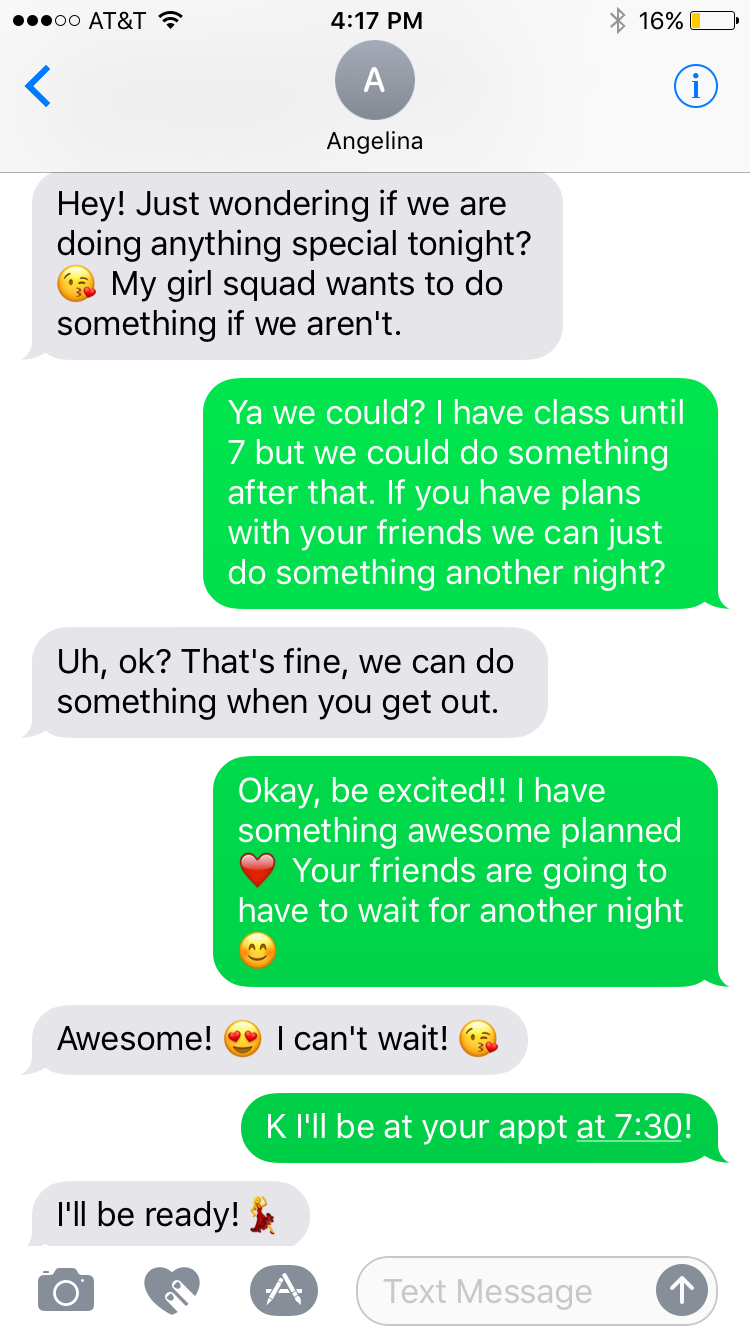
Every person tied to the digital text communication system, be it email or SMS, has had to struggle with the possible misinterpretation of the intent or tone of the messages he or she has sent.  This text conversation mosaic allows us to see into the one couple’s dating process.  As mentioned in DJ Spooky’s Exquisite Corpse anthology, the interconnectedness of our narratives trio allow us to see how the digitalization of information has affected our abilities to communicate, interpret and create media. The boyfriend has forgotten an important date and the girlfriend is quick to judge him for it.  Without the assistance of a close friend, we and the boyfriend may have been lost.  With the addition of this third, binding perspective, we can see the drama for what it is and are spared a potentially damaging moment in a couple’s dating timeline.  


This short glimpse into a relationship mirrors characters and an event from popular culture: the romance between Brad Pitt and Angelina Jolie that went head to head with Jennifer Aniston.  Mixing this narrative into a casual text conversation has the drawback of reducing the real tabloid drama to a simple misunderstanding about the importance of certain relationship ‘milestones’.  But, it gives us the opportunity to create moments of clarity to a situation that many people have experienced while dating.  


Text messages can be easily misinterpreted, as we have nothing but the text itself and a few emoji or animations to give us context.  There is no nuance or stress put on certain words as one would hear in audible speech.  Text messages do allow us to communicate in simple, short messages that could reach a person in situations that would otherwise require one to leave whatever task they are enveloped in to ‘take a call’.  For example, before the dawn of texting, if a parent was in an office meeting and their child called, the parent would either have to ignore the child or leave the meeting.  Now, with the advent of cell phones and text messages, the child could text the parent and the parent could respond, all done while the parent is engaged in the office meeting.  

In the case of our trio of texters, the boyfriend would have had to stave off his uncertainty in real time if the girlfriend had called him instead of texting.  Communicating through text gives him time to come up with a solution. He has the ability text his girlfriend’s best friend in order to procure the necessary information in order to please his girl without making her aware that he has forgotten when they started dating.  The text conversation allows the girls to exchange frustration and correction without needing to be near a telephone or in person.  And so a relationship is saved because conversations are now digitally available, creating time and opportunity to either get it right or take it the wrong way.

Monday, January 23, 2017

Music Mosaic

The music that this mosaic portrays can be found here


This piece portrays the illumination that written, musical, and visual words have on us.  They have the power to open new and different perspectives that enlighten and expose ideas to enrich our lives. We’ve all heard the phrase a picture is worth a thousand words.  Indeed, if one were to contemplate how to describe one picture—in sufficient enough detail—so that not even the slightest pixel is left un-illustrated, one-thousand words may not seem sufficient.  One would have an equally trying time describing the melody, harmony, and rhythm of a classic musical piece.  The same is true about novels.  How do you describe the effect that classic artist’s ideas have had, effects that turned their pieces works to be vetted as essential for all generations to consider?  I cannot tell you.  But I can help.

Part of the trial lies in the difference in perception of the artist and the viewer.  The artist may paint a sliver of light—the last light the crew sees—as the harsh Arctic Ocean’s icy fangs devours their vessel, hoping to show the frailty of man against nature; but the viewer, whose experience of the arctic is harmonious, sees the one ray of sunlight in the painting as hope, that the long, dark winter has finally given way to spring.  So, to describe an art piece, you need to know what you see, but also what they see.

In this piece, a book is found.  A hand reaches out to touch the book.  There are things surrounding the book, why not touch them?  Because they are seen.  Nothing is hidden.  But the book, we don’t know what is inside it.  The book is opened and the journey begins.  That’s how it always starts; every journey begins when something is opened.  The book cannot be closed, the journey must continue.

The shadows around the book reflect the ominous mountain shrouded by clouds.  The greys and blues and tans connect the viewer with the book, the page, the mountain.  The plants, whether stitched in the cloth or growing on the mountain makes no difference—they are both frozen.  The pages blur like the flurries of snow in the canyon.  The yellowing pages give us the color of our main subject: a dog.  Just as the dog searches for what we cannot see, the viewer reads for what he cannot yet know.  The anticipation of discovery keeps both going.


As both continue the journey, it gets more intimate and the light begins to grow.  First a stark line between what is seen and what is shadow, but the line fades and grows—making the border unclear, just like the snow blankets everything into a white mass.  The end is reached, the room is dark no more.  Though the dog has found his master—the reader as well—we ask ourselves: who is the master?  I cannot tell you.  And I cannot help, yet.

Monday, January 16, 2017

The Trouble of Total Transparency

Duke of Windsor: “Now we come to the anointing: the single most holy, most solemn, most sacred part of the entire service”

Male Spectator: “Why don’t we get to see it?”

Duke: “Because we are mortals.”

This excerpt from Peter Morgan’s Netflix series The Crown (2016) episode five “Smoke and Mirrors” comments on the anointing of Great Britain’s current matriarch, Queen Elizabeth II.  Hers was the first televised anointing in British history.  But even in agreeing and inviting the public to attend most of this sacred ceremony, there was one part that the monarchy left enshrouded: the actual anointing itself.  And why?  Was it because they wanted to show the common folk that the royalty was still in control of their lives?  No.  The reason was to preserve the mystery, the sacredness, and the importance of that rite.  The clergy does not get anointed, neither parliament, nor the people.  It is the monarch herself.  The ceremony was for her, not everyone else. Total transparency would have ruined that moment and I argue that it will ruin our world as well. 

In today’s information-laden world, transparency is heralded as one of several things being increasingly claimed as a right in the cyberworld.  We believe that we should be able to do a Google search and come upon any information we deem necessary—and not just for education, but also to satisfy a whimsical thought, a wondering of how x, y, or z works, looks, behaves, sounds.  But we must ask ourselves: is total transparency and total access to information something that will help or damage our societies?  How do you respond when a religious sect wants to keep hidden their holy rites not because they have something to hide, but that they want to preserve that rite’s sacredness?  When do we decide that we have gone from seeking transparency to total invasion of an individual’s or culture’s most cherished customs? 

Invasion of traditions cannot come without consequence.  Almost exactly two years ago, Paris suffered under the fallout of the Charlie Hebdo shooting.  Why? Because a satirical newspaper decided that it’s right to comment and make transparent anything it deemed worthy, threw mockery in the face of Muslims.  And despite warnings, lawsuits, and other threats, Charlie Hebdo kept at it.  The result?  A massacre.  Why?  Because it is illegal—in a religious sense—for some sects in Islam to depict the prophet Mohammed.  And Charlie Hebdo didn’t just depict the sacred prophet, they satirized him.  As much as we wish the shooting hadn't happened, the question must be asked: where is respect in our demand for transparency and distribution of information?  It is apparent that today’s world needs a reminder: just because something is exclusive does not mean that it must be exhibited. 

In exhibiting all things, we must also look at whether making transparent whatever we like is actually making our world a better place.  Sure, one could argue that transparency would cause people, businesses, governments, societies to be more moral, more accountable.  Jeffrey Pfeffer in his article “Openness and transparency will not solve our problems”, speaks to the fact that although the innards of certain ‘conspiracies’ have been exposed, change is still far behind.  He argues that even though it is right in front of us, the majority of people still don’t care to take a look at it.

Why is it, then, that when we finally get our golden egg, we—instead of cracking it open--simply put it back on the shelf?  In his article entitled “Egg McNothin’”, Ian Bogost argues that when something that used to be a luxury—an unattainable or elusive commodity, and in his case the egg McMuffin—becomes commonplace, we lose all allure for it and its value becomes zero.  Why? Because, according to Bogost, humans are sold on the principle of anticipation, of ideas of unattained indulgence. That when we narrowly miss our opportunity for luxury, we desire another chance to claim it.  To elaborate on this fact, Bogost quotes Adam Chandler’s lament about McDonald’s violation of well-established ritual:  

“The 24/7 work world turns “morning” into “that time after whenever you woke up,” and all-day breakfast at McDonald’s only spreads a new layer of oil atop an already greasy period of precarity and overwork. “In demanding eternal breakfast,” Chandler mourns, “America is reverting to its adolescence”.

Adam Chandler may be on to something more than just begrudging the addition of breakfast to our list of instantly gratifying options.  It is often the character of adolescents to act without acknowledgment of consequences.  Indeed it could be argued that in our demand for transparency and total access, we are actually reverting to more juvenile ways of thinking.  We want to know what that CEO did with his last paycheck.  We want breakfast no matter when we get out of bed.  We want to crucify that woman for her insensitive tweet.  We don’t think that what the CEO does with his own money is none of our concern, so long as it’s legal.  We don’t comprehend that the suffering tweeter is now unable to get work, couldn’t pay her rent, and is now homeless.  But we should.

Is total transparency something to be sought after?  Perhaps, but probably not.  Security cameras are great tools that can reveal the identity robbers when they thought they were hidden.  But people still don’t put security cameras in their bathroom.  Total transparency in all things robs mankind of the respect, ritual, and private matters that make life interesting and livable. 

Toward the end of the Crown episode Smoke and Mirrors, the Duke of Windsor says it all:

“Who wants transparency when you can have magic?”

“Who wants prose when you can have poetry?”

“Pull away the veil and what are you left with? An ordinary young woman of modest ability and little imagination. But wrap her up like this, anoint her with oil, and hey presto what do you have?”

“A goddess.”

Who would want to rob the world of magic, poetry, and deity?  Those who desire total transparency.

References:

Tuesday, January 10, 2017

Begin Blog

Testing, testing.  Does this thing actually work?  I hope it does, my grade is riding on this blog.